Why We Need to Beat the Sun by 100 Million Degrees
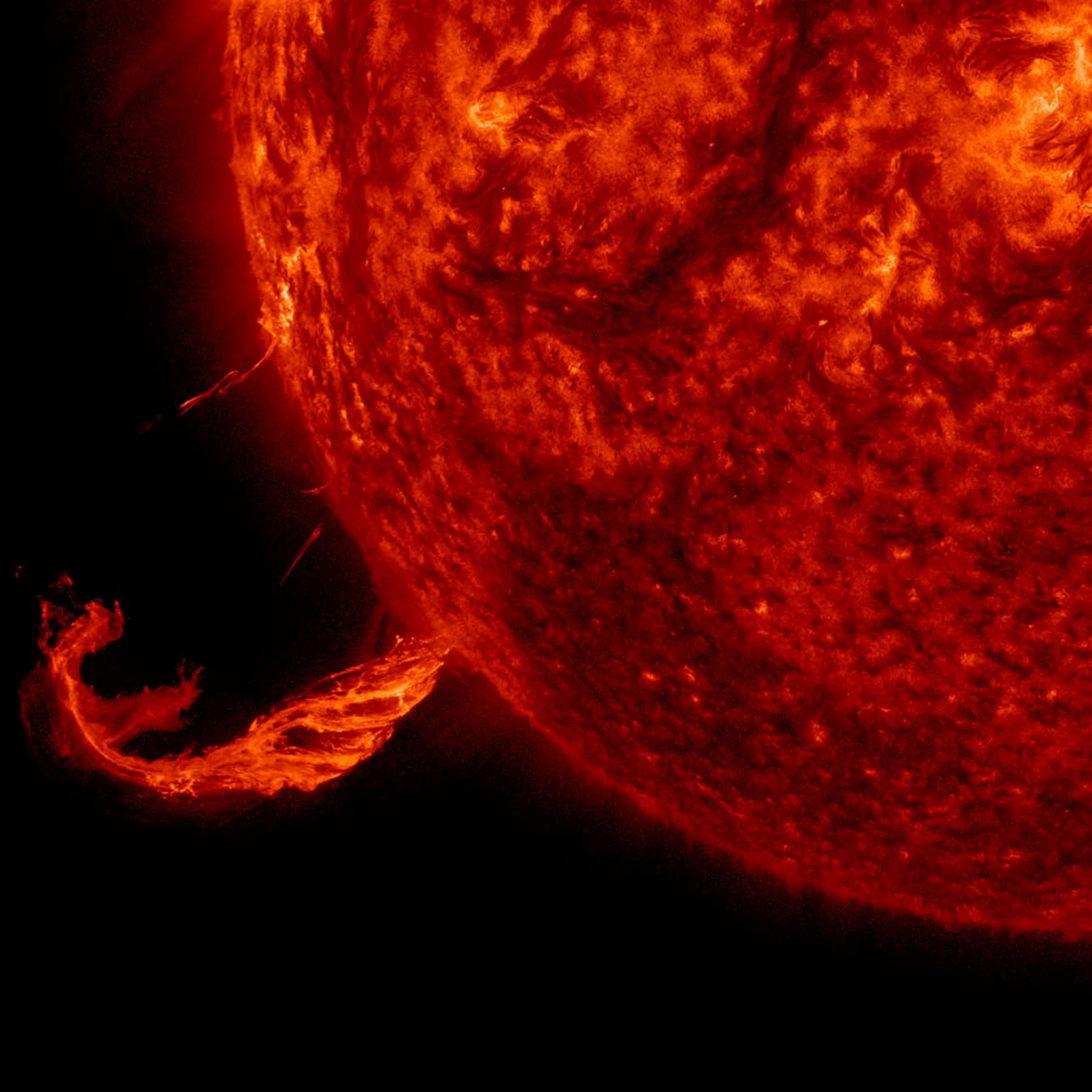
The core of the Sun puts out about as much heat per cubic meter as a compost heap. Work out why, and you understand why fusion reactors are so hard to build.
The core of the Sun puts out about 276 watts of heat per cubic meter [1]. An active compost heap in a garden produces roughly that. Your own body, measured the same way, beats it.
That number is not a typo, and it is not a trick of units. The place where hydrogen fuses into helium, at fifteen million degrees and a density 150 times that of water [2], generates heat at a rate a gardener would recognize.
Every fusion reactor on Earth aims for temperatures around 100 to 150 million degrees Celsius. Seven to ten times hotter than the center of the Sun. Once you understand why the Sun is so slow, you understand why we have to run so hot, and why fifty years of effort still have not put a single watt of fusion power on any electrical grid.
A proton waits a billion years
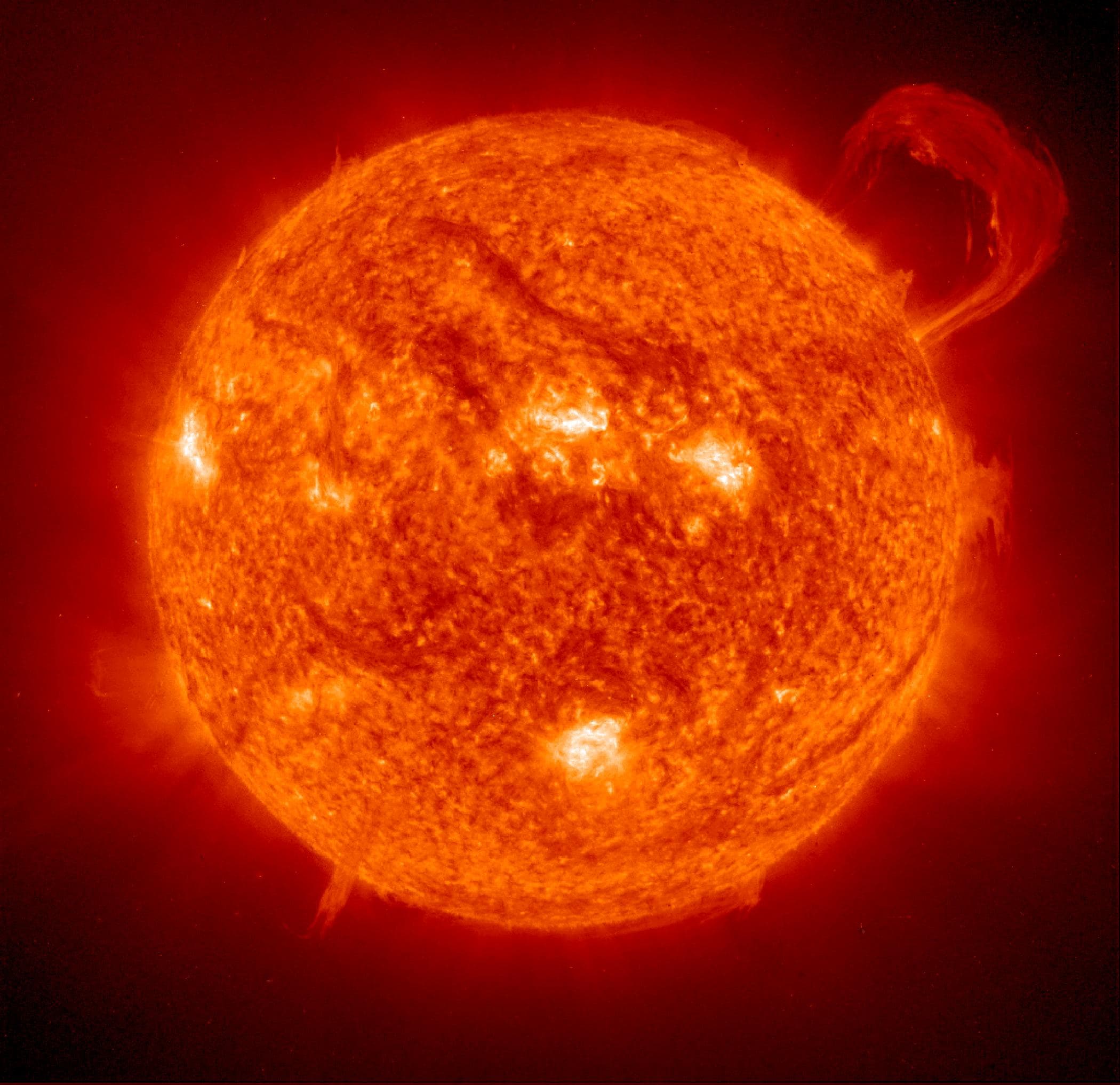
The Sun burns hydrogen through the proton-proton chain. The first step in that chain requires two protons to collide and stick together, which means one of them has to convert into a neutron on the spot. That conversion runs on the weak nuclear force.
The weak force earns its name. Two protons in the solar core collide constantly, and almost every collision ends with them bouncing apart. The rare successful fusion happens so seldom that an average proton sitting in the core waits on the order of a billion years for its turn.
So the Sun is not a furnace. It is an enormous vat of hydrogen in which a vanishingly small fraction of the fuel reacts at any moment. Total output reaches 3.8 × 10²⁶ watts because you multiply a tiny number by a volume the size of a star.
Two things make that work, and we can buy neither of them. The first is gravity supplied by two thousand trillion trillion kilograms of mass, which holds the fuel in place with no equipment. The second is time. The Sun has been running this reaction for 4.6 billion years and nobody is waiting on a quarterly result.
We cannot afford to wait
Strip away the mass and the patience, and the physics stops cooperating. A reactor that fits inside a building has perhaps a few tens of cubic meters of plasma. At solar power density that gives you a few kilowatts, which will not run a neighborhood.
Engineers compensate in two places.
They change the fuel. Instead of ordinary protons, reactors burn deuterium and tritium, two heavy isotopes of hydrogen. Deuterium and tritium fuse through the strong nuclear force with no weak-force bottleneck, and their reaction cross-section, the probability that a collision produces fusion, is far larger than anything else available [3]. The D-T reaction also peaks at a lower temperature than its competitors, which matters when every degree costs money.
Then they raise the temperature past anything the Sun manages. Higher temperature means the nuclei slam together harder and more of them punch through the electrical repulsion that keeps protons apart. Where the Sun compensates for a slow reaction with volume, a reactor compensates for small volume with speed.

Three problems we bought
Raising the temperature by a factor of ten solves the reaction rate and creates everything else.
You cannot touch it
No material survives contact with matter at 150 million degrees. Tungsten, the most stubborn metal in the catalog, melts at 3,400 °C.
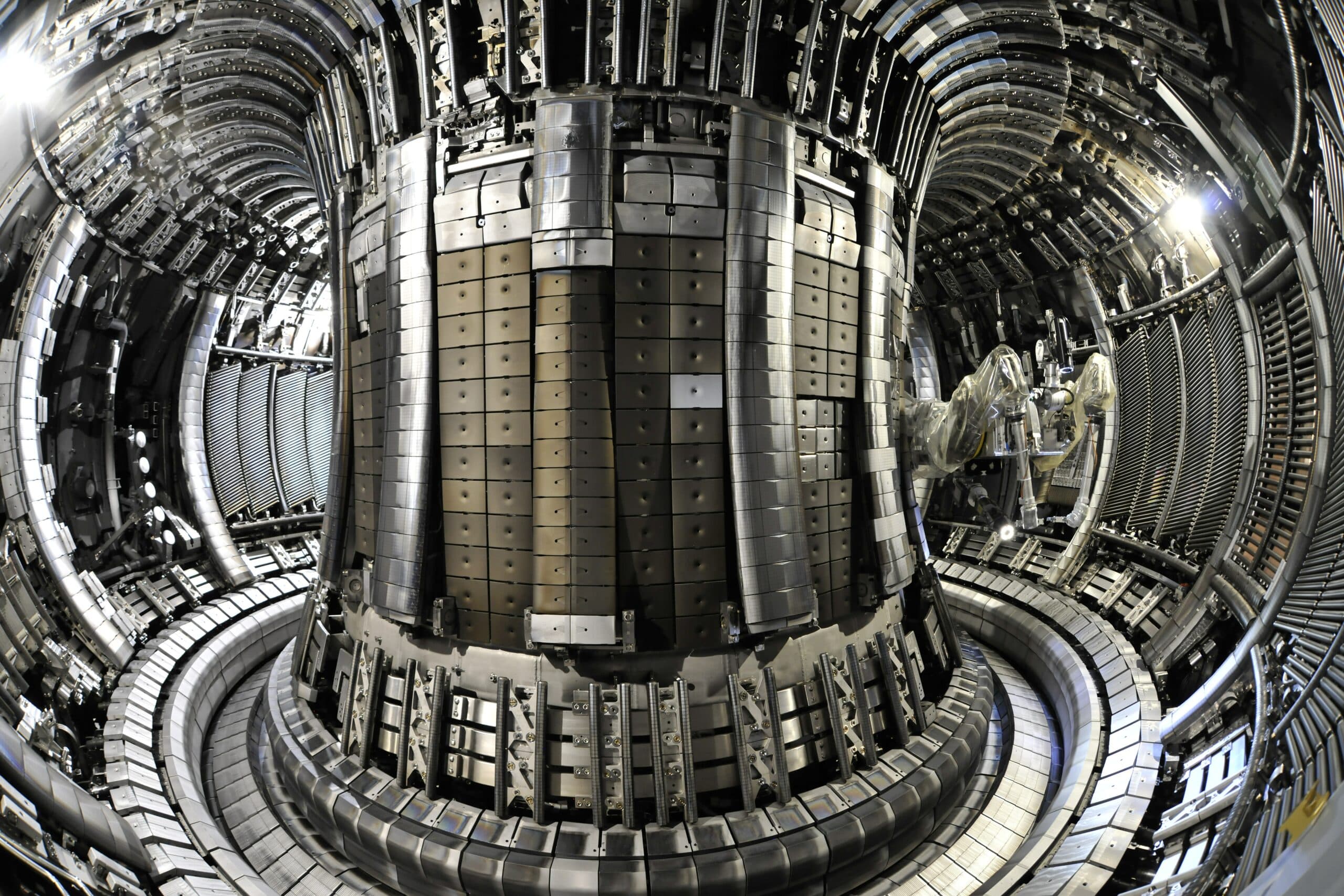
The escape route comes from the state of the fuel. Above a few thousand degrees the electrons strip away from their nuclei and the gas becomes plasma, a soup of charged particles. Charged particles follow magnetic field lines, so a strong enough magnetic field holds the plasma in a shape that never touches a wall.
Strong enough turns out to be the hard part. Confinement quality improves sharply with field strength, and field strength depends on the magnets. Copper coils dissipate too much power to be worth it, and conventional superconductors cap out around 5 to 6 tesla in machines this size. High-temperature superconducting tape, which manufacturers only learned to produce in usable lengths over the past decade, pushes past 12 tesla. That single materials advance is the reason a wave of private fusion companies exists at all.
The plasma will not sit still
A magnetic bottle leaks. Heat and particles drift across the field lines faster than any simple model predicts, driven by turbulence at scales of millimeters that no one can compute from first principles across a whole machine.
Plasma physicists track this with the energy confinement time, the number of seconds the plasma holds its heat once you stop pumping energy in. John Lawson worked out in 1957 what combination of temperature, density and confinement time a reactor needs before it produces more than it consumes [4], and the field has been chasing that combination since.
Push the density or the current too far and the plasma tears itself apart in a disruption, dumping megajoules into the wall in a few milliseconds and putting mechanical stress on the vessel that engineers design entire structures around [5]. Turbulence and disruption control absorb a large share of the field's research effort, and they are the reason nobody can simply build a bigger magnet and declare victory.
Half the fuel does not exist
Deuterium is easy. One in every 6,400 hydrogen atoms in seawater is deuterium, and separating it is old industrial chemistry.
Tritium is the problem. It decays with a half-life of 12.3 years, so the Earth retains almost none. The world's entire civilian stockpile, produced as a byproduct in a handful of Canadian heavy-water reactors, amounts to a few tens of kilograms, and a single commercial fusion plant would consume something like that per year.
A working reactor has to make its own. Each D-T fusion throws off a neutron, and a blanket of lithium surrounding the plasma captures those neutrons and produces tritium. Run the cycle right and the plant breeds more tritium than it burns.
Nobody has demonstrated that. Every operating experiment buys its tritium. The blanket has to breed above break-even while surviving neutron damage, while tritium leaks through hot metal walls at rates that are hard to measure and harder to stop [6]. The tritium cycle gets the least press coverage of the three problems here, and it stands the best chance of setting the real timeline.

Where this stands in late 2026
As of September 2026, no fusion device has delivered electricity to a grid, and none is close to doing so.
ITER, the international tokamak under construction in southern France, remains the largest machine in the field and the most delayed. Its schedule has slipped by more than a decade across successive revisions, and the collaboration now targets deuterium-tritium operation in the late 2030s.
The private companies moved faster by building smaller. Commonwealth Fusion Systems, an MIT spinout, is assembling SPARC in Devens, Massachusetts, on the bet that high-field HTS magnets let a compact tokamak reach the same physics as a machine several times its size [7]. The company installed the first of eighteen toroidal field magnets in early 2026, each one weighing 24 tonnes and cooled to 253 degrees below zero to carry more than 30,000 amps. First plasma has slid from 2025 to 2026 and now to 2027.
Other groups pursue different geometry. Stellarators twist the magnetic field into a shape that avoids disruptions at the cost of brutal engineering tolerances. Helion compresses plasma in pulses and aims to extract electricity from the expanding field without a steam turbine.
You will read headlines about experiments producing more energy than they consumed. Those claims rest on at least three different definitions of energy in and energy out [8], and the gap between the friendliest definition and the one that matters for a power plant spans several orders of magnitude. The 2022 ignition result at the National Ignition Facility counted only the laser light that reached the target, and ignored the roughly 300 megajoules the lasers drew from the wall to deliver 2 megajoules of it [9].
Beating the Sun
The Sun does not offer us a template. It offers a demonstration that the reaction works, under conditions no engineer can reproduce, at a pace no utility would tolerate.
We are attempting something the universe has only ever done inside objects held together by their own gravity, and we want it in a room, on a schedule, with a maintenance crew. The physics has been understood since the 1950s. Everything since has been an argument with materials, magnets, and the fuel supply.
References
-
D. D. Clayton, Principles of Stellar Evolution and Nucleosynthesis. New York, NY, USA: McGraw-Hill, 1968.
-
J. N. Bahcall, M. H. Pinsonneault, and S. Basu, "Solar models: Current epoch and time dependences, neutrinos, and helioseismological properties," Astrophys. J., vol. 555, no. 2, pp. 990–1012, Jul. 2001.
-
J. P. Freidberg, Plasma Physics and Fusion Energy. Cambridge, U.K.: Cambridge Univ. Press, 2007.
-
J. D. Lawson, "Some criteria for a power producing thermonuclear reactor," Proc. Phys. Soc. B, vol. 70, no. 1, pp. 6–10, Jan. 1957.
-
J. Wesson, Tokamaks, 4th ed. Oxford, U.K.: Oxford Univ. Press, 2011.
-
M. Abdou et al., "Physics and technology considerations for the deuterium–tritium fuel cycle and conditions for tritium fuel self sufficiency," Nucl. Fusion, vol. 61, no. 1, Jan. 2021, Art. no. 013001.
-
A. J. Creely et al., "Overview of the SPARC tokamak," J. Plasma Phys., vol. 86, no. 5, Oct. 2020, Art. no. 865860502.
-
S. E. Wurzel and S. C. Hsu, "Progress toward fusion energy breakeven and gain as measured against the Lawson criterion," Phys. Plasmas, vol. 29, no. 6, Jun. 2022, Art. no. 062103.
-
H. Abu-Shawareb et al., "Lawson criterion for ignition exceeded in an inertial fusion experiment," Phys. Rev. Lett., vol. 129, no. 7, Aug. 2022, Art. no. 075001.