Could You Actually Build Spider-Man's Web Fluid?
Spider silk is tougher than Kevlar, and a lab has already shot fibers from a needle. The wrist cartridge still fails, and a calculator is enough to show why.
Peter Parker mixes something in a beaker in his bedroom. A few scenes later he swings between office towers on a rope he made himself. Which part of that breaks first?
Not the silk. Spider silk performs about as well as the films suggest, and biologists have measured it for decades. The cartridge on his wrist is where the story collapses, and you can show that with a calculator.
The silk is as good as advertised
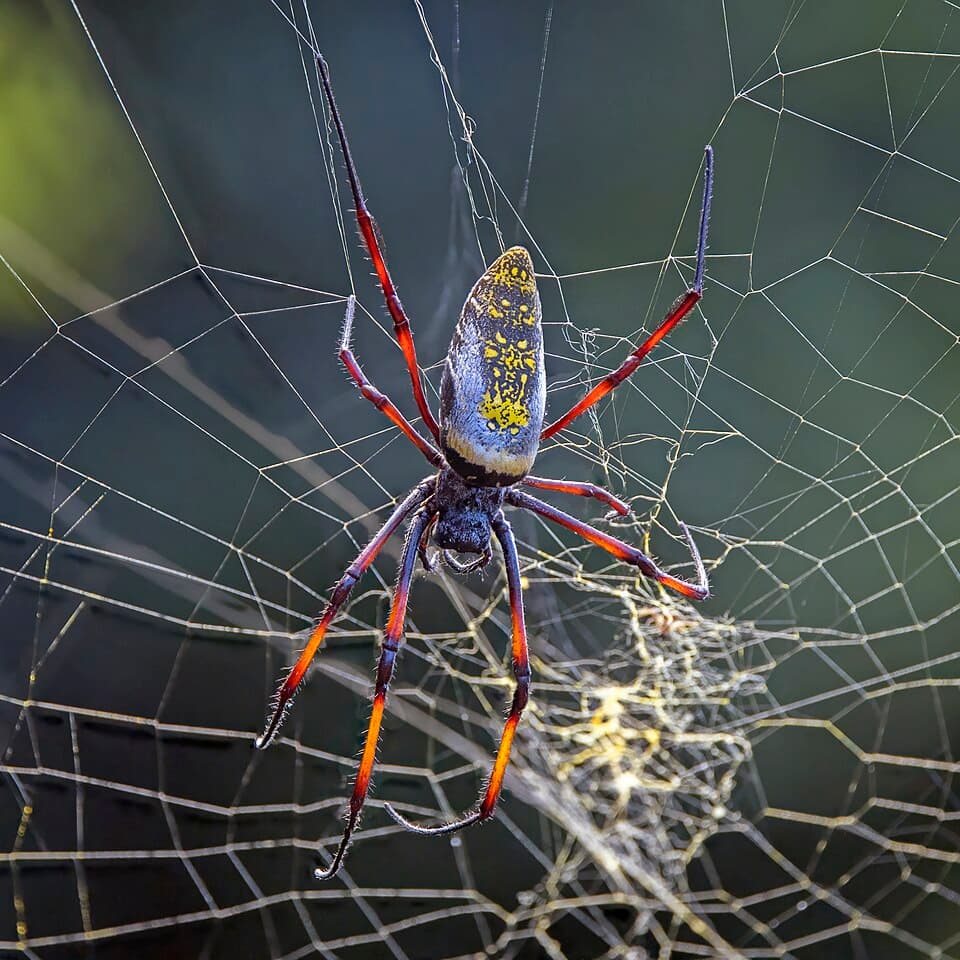
Spiders spin several kinds of silk. The one that matters here is dragline silk, produced in the major ampullate gland, which a spider uses as a lifeline and as the spokes of its web. Its tensile strength sits around 1 GPa, though published values range from roughly 0.9 to 1.7 GPa depending on the species and how fast you pull the fiber.
Per unit weight, that beats structural steel. A solid steel cable of the same diameter still wins on raw force, so the comparison only holds once you account for mass.
Strength alone undersells it. Dragline silk stretches close to 30% of its length before it snaps, so it absorbs far more energy than a fiber that fails at 3% strain. Kevlar behaves like very strong glass: enormous stiffness, little give. Spider silk behaves like a climbing rope. If you plan to catch a falling person, you want the rope.
So the material passes. The problem starts at the nozzle.
Spiders never shoot their webs
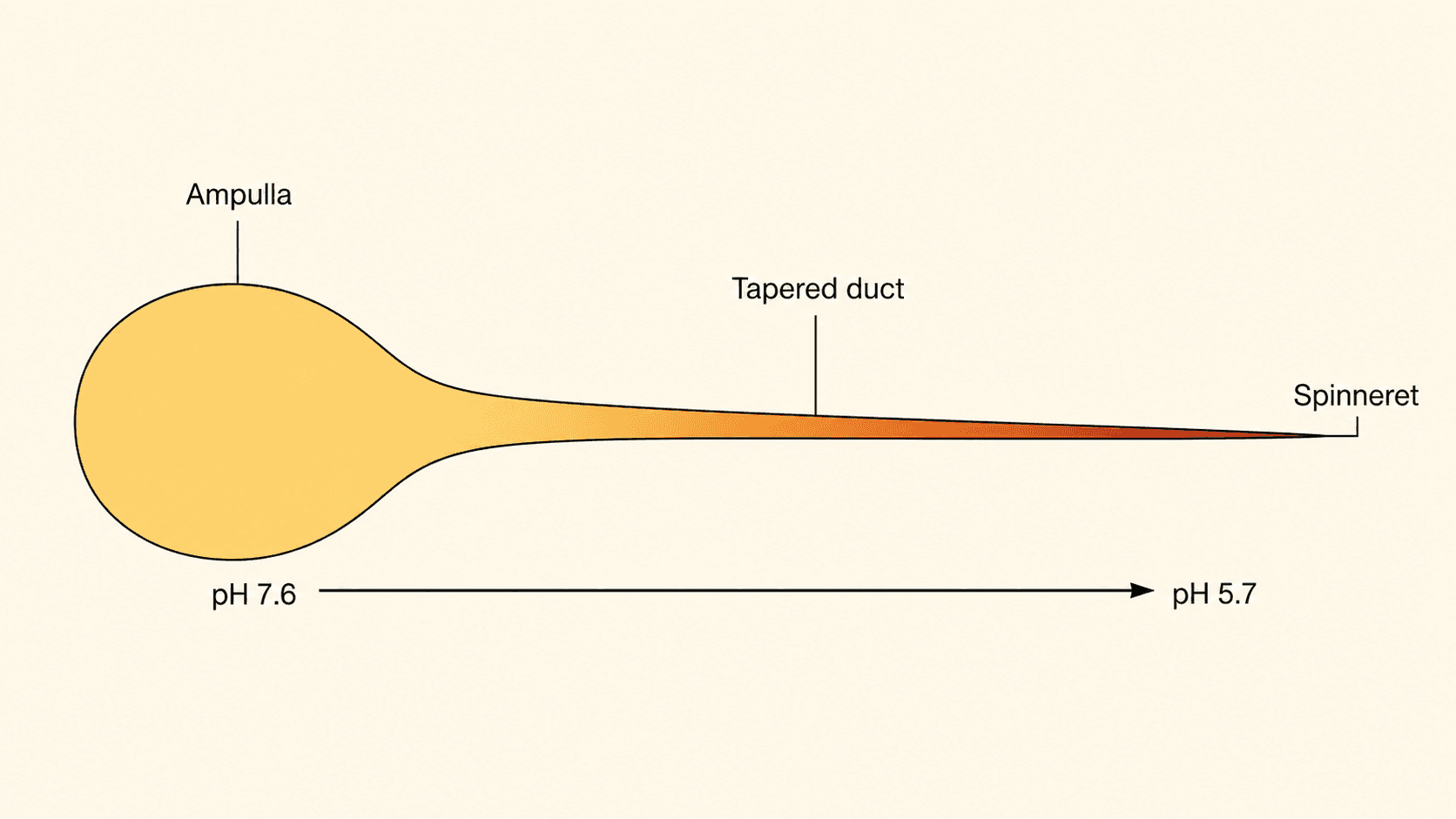
A spider does not carry finished thread. It stores a concentrated protein solution, 30 to 50% by volume, in the ampullate gland. The proteins are called spidroins, and inside the gland they stay dissolved and harmless.
Fiber forms along the spinning duct, and three changes drive it:
- pH. Anna Rising's group at Karolinska pushed ion-selective microelectrodes into the gland of Nephila clavipes and watched pH fall from 7.6 to 5.7 by the midpoint of the duct. An enzyme, carbonic anhydrase, generates the protons that create the gradient. Block the enzyme and the gradient collapses.
- Ions. Sodium and potassium leave the solution while chloride and phosphate enter.
- Shear. The spider drags the line out of its body. That mechanical pull aligns the protein chains.
Under those conditions the spidroin terminal domains change shape, the chains lock into β-sheets, and a solid fiber appears in a fraction of a second.
Marco Lo Presti at Tufts puts it plainly: spiders cannot shoot their web. They spin it out of the gland, touch a surface, and draw the line out behind them.
A web-shooter strapped to a wrist has a hole. It has no tapered duct, no enzyme maintaining a pH gradient over a few millimeters, and nothing pulling the fiber. Peter would need to build a spinning organ, not a sprayer.
Now count the milliliters
Suppose you solve the chemistry anyway. Feed the shooter a fluid that hardens on contact with air, at full spider-silk strength. Load the cartridge and swing.
Start with the load. Peter plus suit comes to about 75 kg. At the bottom of a swing he pulls roughly 3g, so the line carries about 2,200 N.
Peak load                   ≈ 2,200 N
Tensile strength            ≈ 1 GPa = 1,000 N/mm²

Minimum cross-section       = 2,200 / 1,000  ≈ 2.2 mm²
→ line diameter             ≈ 1.7 mm

Length of one swing         ≈ 20 m
Volume of fiber             = 2.2 mm² × 20,000 mm
                            = 44,000 mm³ ≈ 44 mL   ← for ONE swing
Forty-four milliliters. Three tablespoons of fluid, gone in a single arc across one street.
The cartridges in the films look about the size of an AA battery, which holds around 8 mL. Even at perfect conversion, with zero waste and no safety factor, Peter runs dry a quarter of the way through his first swing.

Push back on the assumptions and the answer holds. Maybe 3g overstates the load, or 20 m overstates the swing. Halve both and you still need 11 mL. Add the safety factor any engineer would demand on a line carrying a human body, and the number climbs past the original 44. The gap between the cartridge and the requirement runs to a factor of ten or more, and no reasonable choice of inputs closes it.
That argument beats any claim about the chemistry being impossible, because you don't have to trust me. Open a calculator and check.
Someone built a working version anyway
In 2024, Marco Lo Presti and colleagues at the Tufts University Silklab published a device in Advanced Functional Materials that shoots a fluid, hardens it in flight, sticks it to an object, and lifts the object. The discovery started as an accident: Lo Presti was cleaning glassware with acetone during an adhesives project and noticed web-like material forming at the bottom of the beaker.
Their fiber comes from silkworm cocoons, not spiders. The team boils the cocoons down to fibroin, the structural protein, which is far easier to obtain in quantity than spidroin. Fibroin turns into a soft hydrogel over several hours in ethanol or acetone, too slow to be useful. Adding dopamine, the same chemistry barnacles use to glue themselves to rocks, cuts that to an instant by pulling water out of the solution.
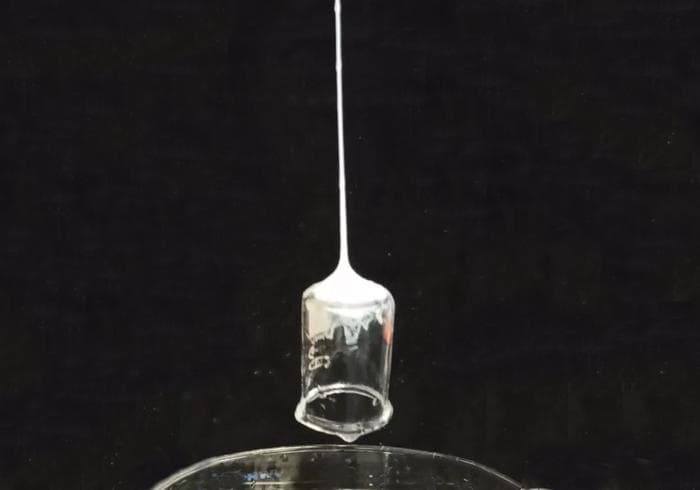
The shooter itself is a coaxial needle with two concentric openings. Fibroin and dopamine travel through the inner channel, acetone through the outer one. The acetone sheath triggers solidification, evaporates in flight, and leaves a sticky fiber that grabs whatever it touches. Chitosan raised the tensile strength by up to 200 times, and a borate buffer raised adhesion about 18-fold. The fibers pick up objects more than 80 times their own weight. Lo Presti's team demonstrated it on a cocoon, a steel bolt, a lab tube floating on water, a scalpel half-buried in sand, and a wood block, all from about 12 centimeters away.
The honest numbers: twelve centimeters is not a city block, and the team reports that natural spider silk still outperforms their fiber by a factor of about 1,000. Neither of those facts makes the work less impressive. Lo Presti solved the problem spiders solve with a duct, and he did it with a nozzle and a solvent.
What Peter got wrong
The chemistry was never the wall. Rising's group mapped the gradients that turn spidroin into fiber, Lo Presti built a device that hardens a protein stream in open air, and companies like Spiber and AMSilk ferment recombinant silk proteins by the kilogram. Every piece exists in some lab.
The wall is that spinning a fiber takes a process, and a process needs length, time, and mass. Peter has a wrist.
If he wants to swing across Manhattan, he needs a backpack. Somewhere around 44 mL per swing, times a few dozen swings, plus the pumps.
References
- Andersson, M., et al. (2014). Carbonic Anhydrase Generates CO₂ and H⁺ That Drive Spider Silk Formation Via Opposite Effects on the Terminal Domains. PLoS Biology 12(8): e1001921. Open access
- Meadows, R. (2014). How Spiders Spin Silk. PLoS Biology 12(8): e1001922. A plain-language summary of the paper above.
- Rising, A. & Johansson, J. (2015). Toward spinning artificial spider silk. Nature Chemical Biology 11, 309–315.
- Askarieh, G., et al. (2010). Self-assembly of spider silk proteins is controlled by a pH-sensitive relay. Nature 465, 236–238.
- Lo Presti, M., et al. (2024). Dynamic Adhesive Fibers for Remote Capturing of Objects. Advanced Functional Materials. DOI: 10.1002/adfm.202414219 · Press release
- Andersson, M., Johansson, J. & Rising, A. (2016). Silk Spinning in Silkworms and Spiders. International Journal of Molecular Sciences 17(8): 1290. Open access.